 |
Grantronics ELNEC Programmers and Tools LabProg+ |
 |
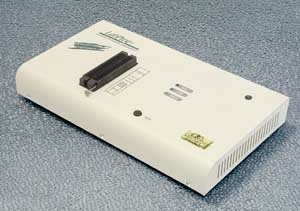 Universal programmer Universal programmer
* DOS software has been discontinued |
Feature Summary
Please note: If you are looking for speed, consider the JetProg. See speed comparison at the end of this page.
Socket, pin drivers and DACs
- 48-pin DIL ZIF (Zero Insertion Force) socket accepts both 300/600 mil devices up to 48-pin
- Three D/A converters for VCCP, VPP1, and VPP2, with controllable rise and fall time and current limitation
- TTL driver provides H, L, CLK, pull-up, pull-down on all 48 pins
- full support of Low Voltage circuits from 1.8 V up
- autocalibration
Device support (programmer)
- EPROM: NMOS/CMOS, 1702*, 2708*, TMS2716*, 27xxx and 27Cxxx series, with 8/16 bit data width, full support for LV series
- EEPROM: NMOS/CMOS, 28xxx, 28Cxxx, 27EExxx series, with 8/16 bit data width
- Flash EPROM: 28Fxxx, 29Cxxx, 29Fxxx, 29BVxxx, 29LVxxx, 29Wxxx, 49Fxxx series, from 256kbit to 32Mbit, with 8/16 bit data width, full support for LV series
- Serial E(E)PROM: 17Cxxx, 24Cxxx, 24Fxxx, 25Cxxx, 59Cxxx, 85xxx, 93Cxxx, NVM3060, MDAxxx series, full support for LV series
- PROM: AMD, Harris, National, Philips, Signetics, Tesla, TI
- NV RAM: Dallas DSxxx, SGS/Inmos MKxxx, SIMTEK STKxxx, XICOR 2xxx, ZMD U63x series
- PLD: SPLD, CPLD series: Altera, Atmel, AMD-Vantis, Lattice, NS, Philips, TI, Xilinx, ...
- Microcontrollers 48 series: 87x41, 87x42, 87x48, 87x49, 87x50 series
- Microcontrollers 51 series: 87xx, 87Cxxx, 87LVxx, 89Cxxx, 89Sxxx, 89LVxxx, all manufacturers, Philips 87C748..752 series
- Microcontrollers Intel 196 series: 87C196 KB/KC/KD/KT/KR/...
- Microcontrollers Atmel AVR: AT90Sxxxx, ATtiny series
- Microcontrollers Microchip PIC: PIC12Cxxx, PIC16C5x, PIC16Cxxx, PIC17Cxxx, PIC18Cxxx series
- Microcontrollers Motorola: 68HC11 series
- Microcontrollers National: COP8xxx series
- Microcontrollers NEC: uPD78Pxxx series
- Microcontrollers Scenix (Ubicom): SX18xxx, SX20xxx, SX28xxx series
- Microcontrollers SGS-Thomson: ST6xx series
- Microcontrollers TI: MSP430 series
- Microcontrollers ZILOG: Z86xxx series
Note: * = obsolete device, programming with additional E-2708 module
Actual DEVICE LIST
Device support (IC tester)
- TTL: 54,74 S/LS/ALS/H/HC/HCT series
- CMOS: 4000, 4500 series
- Static RAM: 6116 .. 624000
- User definable test pattern generation
Device operations
- standard:
- automatic ID-based selection of EPROM/Flash EPROM
- blank check
- read
- program
- verify
- erase
- configuration and security bit program
- checksum
- security:
- insertion test
- contact test
- ID byte check
- special:
- production mode (automatic start immediately after device insertion)
- auto device serial number increment
- statistics
- count-down mode
Buffer operations
- view/edit, find/replace
- fill/copy, move, byte swap, word/dword split
- checksum (byte, word)
Supported file formats
- unformatted (raw) binary
- HEX: Intel, Intel EXT, Motorola S, MOS, Exormax, Tektronix, ASCII-SPACE-HEX
- JEDEC (ver. 3.0.A), eg. from ABEL, CUPL, PALASM, TANGO PLD, OrCAD PLD, PLD Designer ISDATA, etc.
PC system requirements
- IBM PC compatible, from AT to Pentium Pro, free 512 kB RAM
- CD-ROM, Hard disk with 3 MB free space
- operating system: DOS 3.2 or higher, Windows 3.x or higher
- free parallel port (as for printer connection), bi-directional (PS/2) port recommended
General
- operating voltage 100-240V AC using included universal power supply (international customers may have to provide an IEC-C8 power cable)
- power consumption 12W active, about 1.5W sleep.
- dimensions 275L x 157W x 47H mm (10.8"L x 6.2"W x 1.85"H)
- shipping weight (with power supply) about 2.6kg
- temperature 5° to 40°C
- humidity 20% to 80%, non condensing
Package includes
- connection cable
- diagnostic pod for self test
- dust cover for ZIF socket
- power supply adaptor
- power supply mains cable (Australia and New Zealand)
- user manual
- software on mini CD
- registration card
Description
LabProg+ is a universal programmer that supports all
programmable silicon technologies. Powerful pin-driver provides logic level, pull-up/pull-down, clock, ground, one VCC supply and two programming
supplies and read on each of all 48 pins independently (full support of Low Voltage circuits from 1.8V up). This advanced design gives it the ability to program almost every programmable device in DIL up to 48 pins without
an adapter or family-specific module. Support for today's and tomorrow's programmable devices gives engineers the freedom to choose the optimum device for
a new design.
LabProg+ isn't only a programmer. It is also a tester of TTL/CMOS logic ICs and memories. Furthermore, it
can generate user-definable test pattern sequences. LabProg+ is true universal and true low-cost programmer providing the best "value for money" in today's market place.
LabProg+ interfaces with the IBM PC, AT to Pentium Pro, portable or desktop personal computers.
The programmer connects directly to your PC through any standard parallel (printer) port
- no special interface card needed. The LabProg+ control program also supports
bi-directional capabilities of the PC's printer port. Consequently, communication between PC and
LabProg+
is fast and very reliable. Programming an AT29C040A takes about 100 seconds - faster than most competitors. As a result, when used in production, this one-socket-programmer waits for an
operator - not the other way round!
The programmer has on-board intelligence provided by a powerful microcontroller system and support devices.
LabProg+ has been designed for multitasking operating systems and is able to perform time-critical programming sequences independently of the PC. Consequently,
LabProg+ works without any problem on systems running Windows 3.x, Windows 95/98 and Windows
NT/2000/XP.
The programmer performs device insertion tests (wrong or backward position) and contact check (poor contact pin-to-socket) before it programs each device. These capabilities, supported by current limit protection and signature-byte check help prevent chip damage due to operator error.
Built-in protection circuits eliminate damage of programmed device due to mains supply fluctuations, communication error or if PC is
'frozen'. In the event of such errors, the microcontroller in the programmer performs, independently
of the PC,
a specified sequence of steps so that programmed target device remains intact.
The programmer's hardware provides resources for self-test so the control program
may, at any time, check pin-drivers, correct level of all voltages, timing and communication between programmer and PC.
An optimally designed printed circuit minimizes negative programming effects at the socket (such as
'ground-bouncing', supply voltage instability). All the inputs of the
LabProg+ programmer, including the ZIF socket, connection to PC and power supply input, are
protected against ESD to protect the programmer
and programmed circuits against damage due to ESD.
LabProg+ performs programming verification at the marginal levels of supply voltage, which,
improves programming yield, and guarantees long data retention.
The LabProg+ programmer is driven by an easy-to-use control program with pull-down
menus, hot keys and on-line help. You can select a target device by its class, by manufacturer or simply by typing a fragment of vendor name and/or part number. Besides the standard device-related commands (read, blank check, program, verify, erase)
there are some test functions (insertion test, signature-byte check), and some special functions
(auto-increment, production mode - start immediately after insertion of chip into socket). The control program permits data manipulation within the buffer and between the buffer and files and
to perform automatic file format detection and conversion.
The auto-increment function of LabProg+ allows you to assign individual serial numbers to each programmed device. This function simply increments a serial number in the buffer each time a new device is inserted. Furthermore, the function enables the operator to read serial numbers and/or any programmed device identification signatures from a file.
Free software updates are available by download from ELNEC.
Various socket converters are available for the LabProg+ to handle device in
PLCC, SOIC, PSOP, TSOP, TQFP and other packages. Software controlled pin-swapping capability together with universal converters are what give the
LabProg+ the ability to program the target device in any package type. For example just one DIL44/PLCC44 will allow the
LabProg+ to handle all devices in PLCC44 from current device list. The majority of devices with more
than 48 pins can be programmed through an adapter with simple pin interconnection only.
It is important to remember that in most cases new devices require only a software update since the
LabProg+ has 48 true pin drivers, which can perform as required under program control. With our prompt service new devices can be added to the current list of supported devices
- often within hours!
Advanced design of the LabProg+ programmer, including protective circuits, original brand components, and careful manufacturing and
burn-in allows us to provide a three-year warranty on parts and
labour for the programmer (limited 25 000-cycle warranty on ZIF socket).
Please note: The LabProg+ programmer is the upgraded (hardware and firmware) version
of the LabProg-48LV and looks the same. There is an upgrade kit available to
allow the customer to perform this upgrade. Details are at LabProg-48LV to
LabProg+ upgrade.
Special services: Keep-Current and
AlgOR.
Keep-Current service means, that ELNEC ships the latest version of programmer software and updated user documentation (Keep-Current package) to
the customer. A Keep-Current service is your hassle-free guarantee that you are doing the highest quality programming on ELNEC programmers, at minimal cost.
AlgOR (Algorithm On Request) service provides a method for the user to request support for a new device or for a new feature in the control software.
LabProg+ vs JetProg Speed Comparison
| Computer A | Computer B | |||
| Device | LabProg+ | JetProg | LabProg+ | JetProg |
| 27C010 | 39 sec | 24 sec | 32 sec | 20 sec |
| AT29C040A | 110 sec | 38 sec | 90 sec | 28 sec |
| AM29F040 | 165 sec | 49 sec | 139 sec | 42 sec |
| PIC16C67 | 46 sec | 18 sec | 41 sec | 16 sec |
Note. These times depend strongly
on PC speed, LPT port type and operating system free resources. Therefore values are given
for two different PC configurations for comparison.
Computer A: Pentium MMX, 250 MHz, ECP/EPP, WIN98.
Computer B: Athlon, 750 MHz, ECP/EPP on PCI bus, WIN98.


Last updated: 1 November 2003
Copyright © 2003, Grantronics Pty Ltd